

How to Find Your Coloring Style—and Choose Books You’ll Actually Enjoy
Have you ever opened a beautiful coloring book, admired the artwork—and then quietly put it back because you did not know where to begin? The problem may not be motivation or skill. It may simply be that the book does not match the kind of coloring experience you enjoy.
Some people love roomy shapes and quick bursts of color. Others can happily spend an evening on tiny windows, curling vines, or patterned rooftops. One colorist wants familiar animals; another wants a doorway into an imaginary village. Finding the right match makes it much easier to reach for your pencils again.
If you would like to compare currently available options as you read, browse Ambizi’s coloring-book collection for stress relief and relaxation. The catalog is the best place to see every current series and book, while this guide will help you decide which kinds belong on your own shortlist.
What Does It Mean to Find Your Coloring Style?
Your coloring style is not a rule about technique, artistic talent, or which colors “belong” together. It is simply the combination of subjects, page designs, moods, and creative choices that make you want to keep coloring.
Think of it as your preference for the experience of a page. Do you want to finish something cheerful in twenty minutes, or become absorbed in a detailed scene over several sessions? Are you drawn to realistic animals, cozy everyday stories, decorative patterns, or places that could exist only in a fairy tale?
Your style may include:
- Detail level: bold open areas, moderate detail, or intricate line work.
- Subject matter: animals, architecture, nature, fantasy, holidays, history, or patterns.
- Emotional atmosphere: cheerful, cozy, mysterious, adventurous, nostalgic, or quietly imaginative.
- Page composition: a single central subject, a full scene, repeated motifs, or many small objects.
- Available coloring time: quick sessions, leisurely evenings, or a page revisited over several days.
- Color freedom: realistic palettes, imaginative combinations, or a mixture of both.
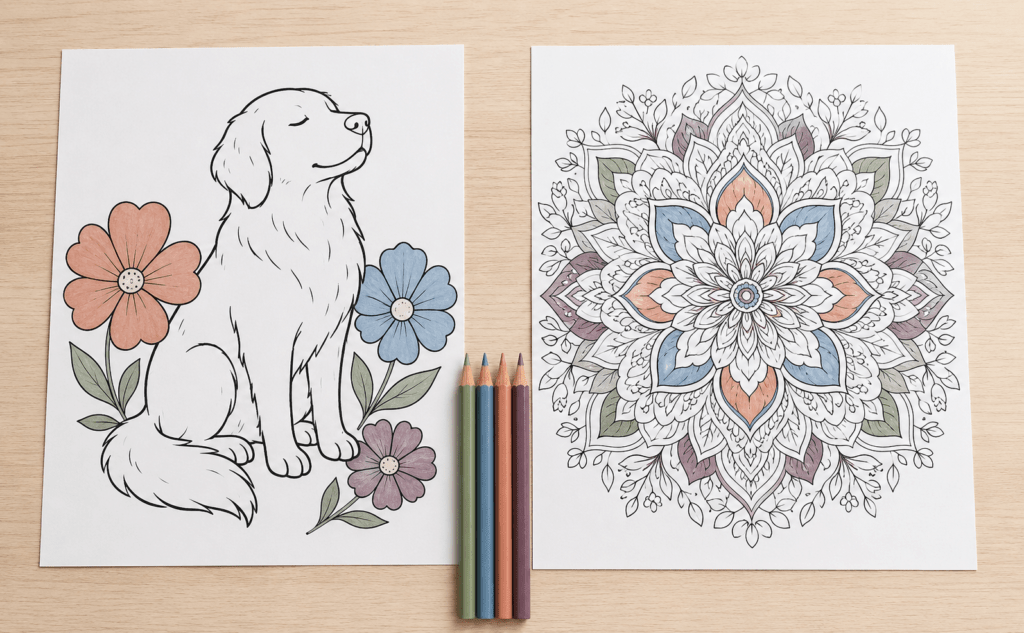
Most people are not one fixed type. You may crave simple pages after a busy day and intricate fantasy scenes on a quiet weekend. Preferences can change with your mood, time, energy, supplies, and curiosity.
A Quick Self-Assessment Before You Choose a Book
You do not need a formal quiz to learn how to choose a coloring book. Look at a few sample pages and ask yourself practical questions:
- Which page would I be happiest to start right now?
- Do small spaces feel inviting or tiring today?
- Would I rather color one character, a complete setting, or a repeating design?
- Do I enjoy deciding how real objects should look, or inventing colors without limits?
- How much uninterrupted time do I usually have?
- Do I want one consistent theme or plenty of variety?
Pay attention to your first response. The page that makes you curious is usually more revealing than the page you think you “should” choose. Interior samples are especially helpful because covers cannot show the rhythm, density, and composition of every page inside.
Six Coloring Styles for Adults
1. The Bold-and-Breezy Colorist
You enjoy getting straight to the color. Large shapes, strong outlines, and uncluttered compositions feel welcoming, especially when you have limited time or are returning to coloring after a long break. Finishing a page can be satisfying, but you do not want the process to feel like an endurance test.
Look for open areas, clear boundaries, friendly subjects, and pages that work with a modest pencil or crayon set. Simple does not mean boring: bold pages give you room to experiment with bright palettes, shading, or unexpected backgrounds without managing dozens of tiny sections.
Adorable Dogs To Color is a verified match for beginners and young colorists who like cheerful dogs, bold outlines, and open spaces. Adult beginners who prefer an easy, playful page may enjoy it too. If you want animal subjects created specifically for a gentler adult coloring experience, explore the next profile as well.
2. The Cozy Storyteller
You are drawn to pictures that seem to have a before and an after. A character gardening, cooking, fishing, or settling beside a fire gives you a small story to enter. You may imagine the weather, the time of day, or what is happening just outside the frame while choosing your colors.
The best pages for you often feature expressive characters, familiar activities, homey settings, and enough environmental detail to create atmosphere. Warm earth tones might appeal one day; on another, you may invent a candy-colored world.
Gnomes: A Day In The Life follows its characters from morning through work, gardening, cooking, fishing, and a peaceful evening. Its 40 full-page scenes create a gentle, story-like sequence, making it a natural choice for colorists who enjoy cozy fantasy and everyday routines.
3. The Nature Wanderer
Animals, woods, farms, and other natural subjects make you want to pause and look more closely. You may prefer recognizable colors and markings, or you may give a horse a blue mane and a woodland creature a jewel-toned home. What matters is the sense of connection to living things and outdoor places.
Nature Wanderers often enjoy a comfortable middle ground: enough detail to make fur, feathers, foliage, and surroundings interesting, with enough breathing room to keep the page approachable. A focused subject can be more appealing than a crowded collage.
The Relaxing Animals To Color series brings together cats, dogs, horses, farm animals, and woodland animals in gentle, approachable illustrations. Because the series is divided by subject, you can begin with the animals you already love instead of committing to a broad assortment.
4. The Whimsical Escapist
You want a coloring page to take you somewhere else. Hidden cottages, glowing lanterns, curious architecture, enchanted shorelines, and impossible little homes are invitations to invent a world rather than reproduce one.
Pages with imaginative settings suit you because there is no single correct palette. A treehouse can glow turquoise; a harbor can sit beneath a lavender sky. You may enjoy detailed scenes, but atmosphere matters as much as complexity. The pleasure comes from deciding what kind of world this is.
The Enchanted Fairy Architecture series explores nature-inspired homes, woodland dwellings, hanging cottages, and lantern-lit harbor villages. The books range from gently detailed to richly intricate scenes, giving imaginative colorists room to choose according to the day.
5. The Pattern Meditator
You enjoy rhythm and repetition: borders, tiles, fabrics, petals, decorative shapes, or rows of small motifs. Rather than wondering what a scene means, you like settling into a sequence of manageable choices. Repeating a limited palette can be just as enjoyable as using every color in the box.
Look for symmetrical designs, decorative elements, clear repeated forms, or pages that contain collections of related objects. Consider whether you prefer strict geometry or looser organic repetition. Also check the scale: tiny motifs reward patience, while larger repeating shapes make shorter sessions easier.
Not every Ambizi title is a dedicated pattern book, so this is a profile where interior samples matter. Decorative architectural details in the Fairy Architecture books or the varied, ornamental elements found in Hodgepodge Hocus Pocus may appeal when you want pattern-like passages within a broader scene. The latter mixes whimsical, spooky, elegant, and decorative moods rather than repeating one format throughout.
6. The Detail Devotee
You notice the windows behind the main character, the leaves around the doorway, and the small objects on the shelf. Detailed pages feel like places to explore. You may build layers with colored pencils, add highlights with gel pens, or return to the same page across several sessions.
Choose full scenes, architectural views, landmarks, and compositions with multiple focal points. Before buying, make sure the line work remains clear enough for the tools you like and that the subject still interests you after the novelty of complexity wears off.
America the Beautiful Coloring Book offers 40 scenes spanning landmarks, wildlife, historic symbols, travel, farms, coasts, small towns, and celebrations. Its balance of detail and open space can suit colorists who want an involved scene without every inch feeling equally dense. Richly intricate entries in the Fairy Architecture series are another option for architectural detail lovers.
How to Experiment Without Buying the “Wrong” Style
A new style does not need to become your permanent favorite to be worthwhile. Treat experimentation as information. Try one page with a different subject, a smaller palette, or a new level of detail and notice what keeps you engaged.
A few low-pressure experiments can teach you a great deal:
- Color the same type of subject once realistically and once imaginatively.
- Set aside fifteen minutes for a detailed page, then stop without requiring yourself to finish.
- Choose three colors for a decorative design and repeat them in different combinations.
- Alternate a full scene with a bold central subject.
- Try the same page with pencils on one occasion and markers or gel pens on another, when the book’s page guidance supports those supplies.
If a page does not hold your attention, that is useful—not a failure. You may learn that you prefer animals to buildings, open designs to intricate ones, or varied collections to tightly consistent themes. You can also revisit Ambizi’s guide to exploring relaxing coloring books for more general tips about complexity, themes, and coloring tools.

Your Coloring Style Can Change—and That Is Part of the Fun
The most useful answer to “What is my coloring style?” may be a small collection of answers. You might be a Bold-and-Breezy Colorist during a lunch break, a Cozy Storyteller on a rainy afternoon, and a Detail Devotee when you have an unhurried evening.
Use the profiles as a vocabulary, not a label. They can help you notice why one book excites you and another remains unopened. The goal is not to choose the most advanced page. It is to choose the page you will genuinely enjoy coloring today.
When you are ready to compare subjects and styles, visit the complete Ambizi coloring-book catalog. Look through the individual book pages and interior samples, follow your curiosity, and let your next coloring session fit the mood you are actually in.